Datasets · Property
Property prices by area: what has been paid, and where the figures come from.
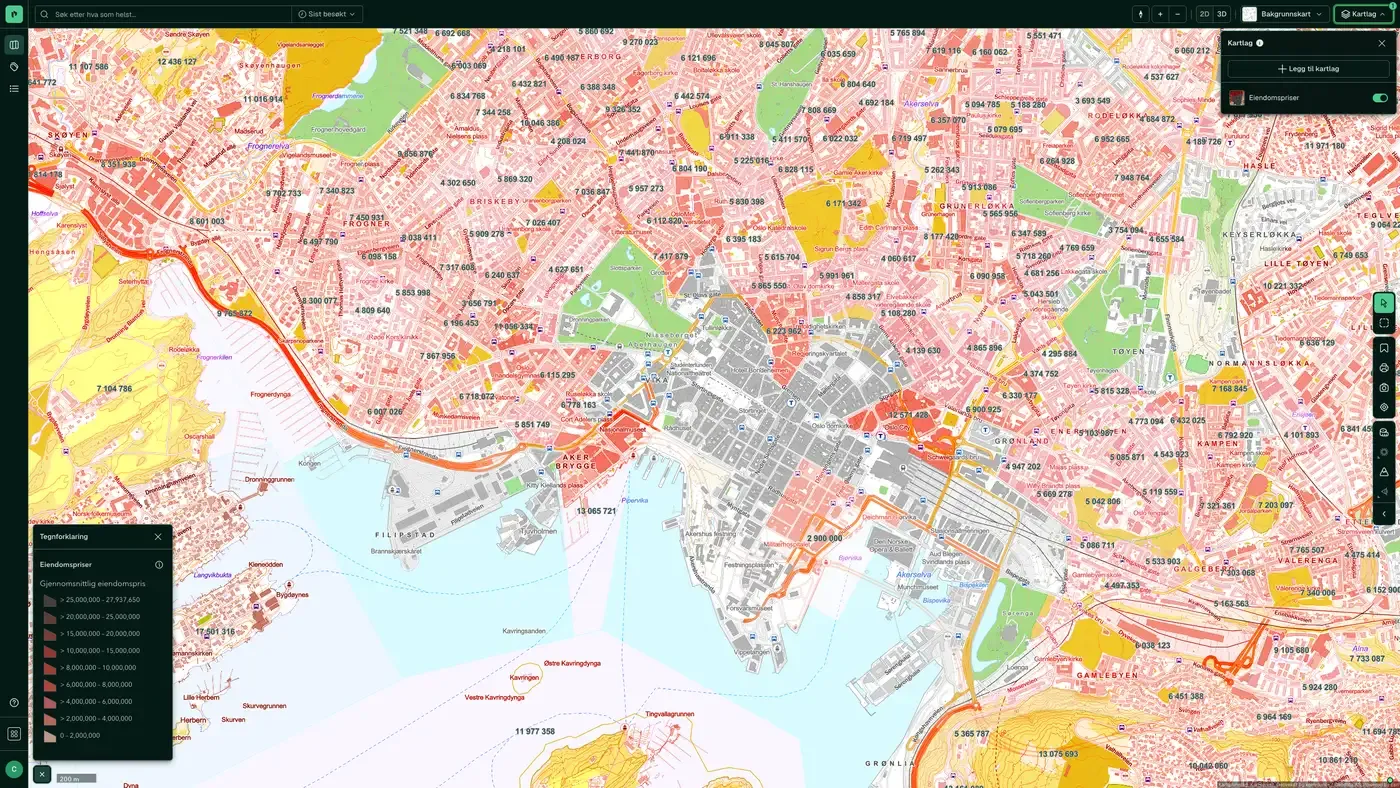
Average property price per basic statistical unit, based on combined transaction data from Eiendomsverdi, Kartverket's matrikkel (cadastre) and Statistics Norway (SSB). Distributed by Geodata AS.
What the dataset contains
Property prices in Placepoint
Average property price per basic statistical unit, based on combined transaction data from Eiendomsverdi, Kartverket's matrikkel (cadastre) and Statistics Norway (SSB). Distributed by Geodata AS. The value is an aggregated area price. Read it as a market indicator, not as a valuation of a single property.
For commercial property agents and valuers, the average price level in the basic statistical unit is key context in sales prospectuses and valuations. Read the dataset together with Number of transactions (property), as more transactions give a more reliable price, and Latest sales (units of use) for individual transactions. Related: Income, Wealth, Households. It is part of our map layers for demographics and property.
This text is based on the dataset documentation, synced 16 October 2026.
More in the Property map layer
Datasets often read together
Number of transactions (property)
The number of registered property transactions per basic statistical unit over a given period, based on the matrikkel.
About the datasetHousing and area reserve (Oslo)
Oslo kommune's own overview of zoned housing in the capital: a compiled zoning reserve that covers both detailed zoning plans (individual projects) and area zoning plans (larger areas).
About the datasetApartment building
All building types classed as housing in the matrikkel, with building geometry from Felles kartdatabase (FKB).
About the datasetBuildings in 3D
Contains buildings across Norway, derived from FKB, aerial photos and LiDAR data (laser).
About the datasetBuilding age
Detailed overview of the year buildings across Norway were built, based on the information municipalities have registered in the matrikkel, with building geometry from Felles kartdatabase (FKB).
About the datasetCoverage Map Case Access
Shows which municipalities we collect public records lists from to power the Saksinnsyn feature.
About the datasetHow to do it in Fusion
Property prices for a property, step by step
Search for the area
Enter an address, or draw the area on the map.
Turn on Property prices
The map layer colours the basic statistical units by price level.
Click a property
The transactions tab shows sales with date and price.
Export
A table to Excel, or a report with the source of every figure.
Where can I see what a home sold for?
Registered changes of ownership are public. In Placepoint, you will find the latest sales for the property, with purchase price and calculated price per m², in the transactions tab and in the Property map layer.
What is the property price in an area?
The Property prices dataset gives the average price per basic statistical unit, compiled from Eiendomsverdi, the matrikkel and Statistics Norway (SSB). It is an area indicator, not a valuation of a single property.
How reliable is the average price?
It depends on how many sales lie behind it. The Number of transactions dataset shows how liquid the area is. Read it together with the price.
How often are prices updated?
Property prices per basic statistical unit are updated monthly. Individual sales come from Kartverket, around 240,000 registered changes of ownership a year.
How often are property prices updated?
Monthly. The frequency follows the source and is shown on the dataset in Placepoint.
Where does the data come from?
From Geodata AS. We collect and quality-check the data and place it on the correct property, with source and date on every field.
How do I see property prices for a property?
Look up the address in Fusion and turn on the Property map layer. The dataset is a separate layer there, and the details appear in the property panel when you click on the map.
Can I get the dataset programmatically?
Yes. The same data is available in Placepoint API and in Placepoint AI through MCP, so you can bring it into your own systems and agents.
Used where decisions really matter