









AI is transforming the property industry: Potential meets practical challenges
Artificial intelligence is changing the property industry. Read about the opportunities and challenges the industry faces.

Placepoint is leading the way in integrating AI into the property industry to improve decision-making processes and make property developers' work more efficient. Despite advanced data and technology, they face challenges in adapting the AI's use of language and ensuring accuracy. The company is balancing ambitions with realities on the road towards innovative solutions for property development.
“We often get asked whether we can't just fix it with AI”, says Peder Sunde, Managing Director of Placepoint. “And we often can, but it takes a bit more than people think”.
Artificial intelligence can increase the efficiency of a process and will clearly play a decisive role in the solutions of the future. There are, however, some challenges. When Placepoint was due to launch a seemingly simple report giving a complete overview of the cadastre (matrikkelen) for a plot, Placepoint had to put in a lot of work to stop the summary produced by the language model from using colloquial wording in the report. “It could write things like ‘unfortunately the building burned down in 1982’ about a building on the plot”, says Jarle Bjørnbeth, CDO at Placepoint. “The word ‘unfortunately’ isn't used incorrectly, of course, and if you were writing a personal letter it would probably make sense, but it doesn't belong in a report that is meant to reproduce the cadastre.”
A common assumption is that AI can provide answers as long as you have enough information and data. That is not so strange – many of the prerequisites for a good AI are precisely that it has large amounts of data to train on. Placepoint has almost all the data on properties in Norway, from cadastral data to social conditions and demographics. So if you want an answer to the question ‘What is Norway's best commercial property’, having a lot of data is not enough. You also need knowledge of what characterises a good commercial property.
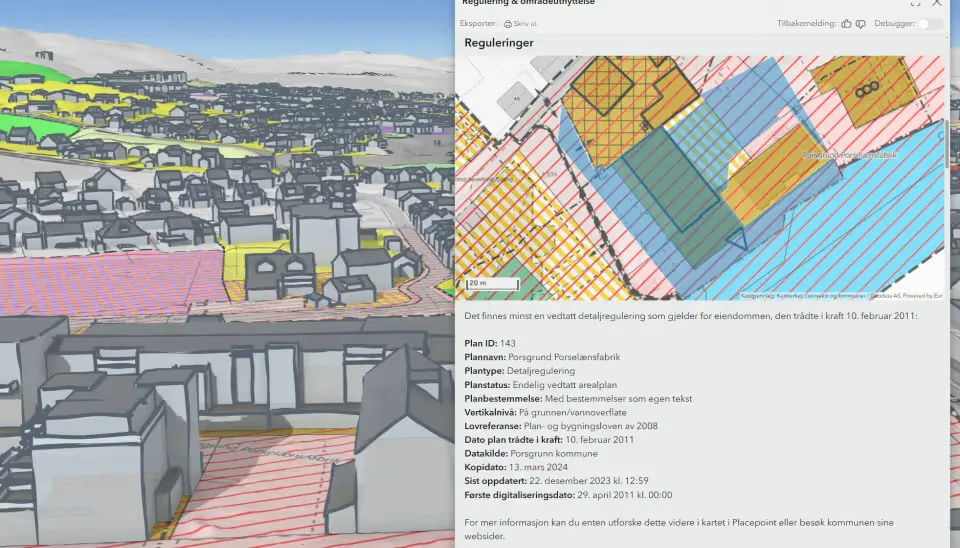
The combination of maps and large amounts of information offers great opportunities for efficiency gains with AI.
We are some way off making the job of property developer redundant”, smiles Sunde. “But we are well on the way to making the Placepoint tool so effective at organising and handling information that it is becoming a ‘must have’ for the industry.
At Placepoint, work is under way to apply AI to complex tasks where the technology is proving particularly effective, for example finding all the planning documents, their most important content and a quick summary of the planning hierarchy for a given area. Training a language model to avoid fabricating information, while keeping the answers meaningful, is a complex challenge. “Even though the language model can technically make up information, much of our work is aimed at ensuring that it operates within the boundaries we set, so that the information remains accurate and relevant. Our main focus is to simplify access to data with efficient solutions, for property developers across the country.”, concludes Bjørnbeth.
If you are curious about what Placepoint can contribute to your property business, get in touch with Peder Sunde.
Read more
How docs.placepoint.no works
Placepoint publishes 1,200+ pages of product documentation in Norwegian and English without manual writing. This is how the pipeline behind docs.placepoint.no works.
TechnologyProptech is no longer an elective in the property industry
Proptech has gone from niche interest to competitive advantage. Technology is now mandatory in property.
TechnologySee the development potential of sites at a glance
With Placepoint you can quickly see the development potential of any site. Make better decisions with data.